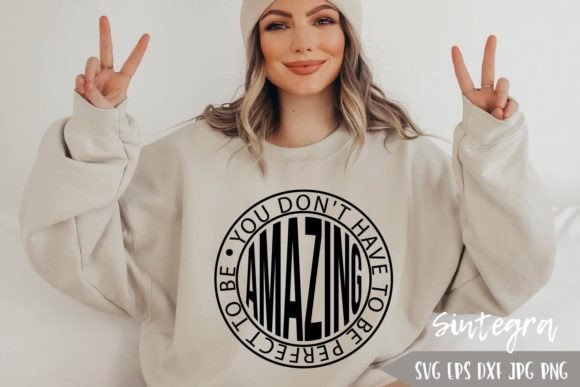
You Don’t Have to Be Perfect to Be Amazi
First Impressions: A Gentle, Grounded Uplift
When I opened You Don’t Have to Be Perfect to Be Amazi for the first time, what struck me wasn’t boldness—it was balance. The phrase lands softly but firmly, with generous letter spacing and a clean, slightly rounded sans-serif that avoids both clinical sterility and overworked whimsy. There’s no clipart clutter, no forced script flourishes—just quiet confidence in its own message. As an embroidery designer who’s stitched hundreds of inspirational quotes, I immediately sensed this one would read well at 3–4 inches wide on a tote bag or sweatshirt front—not too tight, not too sparse. It feels like something you’d stitch for a friend recovering from burnout, or for a teen’s first solo project: affirming without pressure, positive without platitudes.
A Real Project Test: That Embroidered Tote Bag You’ve Been Planning
Last week, I used You Don’t Have to Be Perfect to Be Amazi on a natural canvas tote for a local mental health nonprofit’s fundraiser. We chose mid-weight cotton canvas, medium tear-away stabilizer, and matte polyester thread in soft charcoal. The result? Crisp, legible, and deeply wearable. No skipped stitches, no thread breaks—even through the subtle curve where the handle meets the body. Because the design avoids ultra-thin lines or overlapping letters, it held up beautifully in fill stitch across the fabric’s slight texture. Customers didn’t just glance—they paused. One woman told me she bought two: one for herself, one to gift her daughter starting college. That kind of resonance isn’t accidental. It’s baked into how the phrase breathes on fabric.
Where It Shines (and Where It Needs Care)
You Don’t Have to Be Perfect to Be Amazi works especially well for:
- Custom apparel: Sweatshirts, crewnecks, and relaxed-fit tees—especially when placed center-chest or upper-back for calm visibility.
- Everyday handmade products: Tea towels, pillow covers, and aprons where warmth and sincerity matter more than flash.
- Personalized gifts: Baby onesies (use lightweight cut-away stabilizer), nursery wall hangings, or graduation caps—paired with minimal stitching around the text.
- Small shop merchandise: It reads clearly in printable mockups for Etsy listings, and holds brand consistency across a line of self-love themed crafts.
But be thoughtful in these situations:
- Small hoop sizes (under 4”): The full phrase may feel cramped below 3.5”. Consider using just “Be Amazi” as a standalone variant if space is tight.
- Stretchy or thin fabrics: On jersey or lightweight rayon, add light fusible stabilizer beneath your main stabilizer—this phrase relies on even tension for clean letter edges.
- Dark or textured backgrounds: Test thread contrast early. Light heather gray thread on black fabric can fade; go one tone lighter or use metallic-look thread for gentle lift.
- Curved surfaces like caps: The straight-line layout means it’ll need repositioning or slight scaling to sit cleanly on a curved front panel—don’t force it onto a rigid cap bill without testing.
What This Design Says About Your Craft Business
Using You Don’t Have to Be Perfect to Be Amazi isn’t just about aesthetics—it subtly shapes how customers perceive your work. It signals emotional intelligence in your product curation. When someone sees it stitched on a handmade kitchen towel, they don’t just see a quote—they sense care, intention, and quiet professionalism. That builds trust faster than any sales copy. For Etsy sellers and craft fair vendors, it elevates perceived value: this isn’t filler decor; it’s meaningful design assets with purpose. And because it fits so naturally into mental wellness, self-love, and kindness-themed collections, it strengthens brand cohesion—especially if you pair it with complementary designs like “You Matter” or “Be Kind” in consistent sizing and stitch rhythm.
Practical Designer Notes Before You Stitch
Before committing to a client order or bulk run:
- Always test on scrap fabric—same type, same stabilizer, same thread colors you’ll use in production.
- Review stitch density: If your machine flags high-density areas, check whether the file includes optional low-density versions—or simplify small serifs manually if needed.
- Confirm hoop size compatibility: Does your machine’s standard hoop comfortably fit the full design width? If not, plan for re-hooping or alternate placement.
- Inspect tiny details: Look closely at the “i” dot and “g” tail—are they defined enough for your fabric weight? On fleece or terry cloth, those might need slight enlargement.
- Test black-and-white mockups: Does it retain impact when stripped of color? Strong design does—and this one does.
- Check licensing: Since this is listed as a Graphics product for Crafts, verify whether commercial use (e.g., selling finished embroidered patches) is permitted before listing on your shop.
Final Thought: Design That Stitches Like It Means It
You Don’t Have to Be Perfect to Be Amazi doesn’t shout. It settles—in the stitch, in the fabric, in the hand of the person who receives it. That’s rare. In a market flooded with fast, flashy, forgettable embroidery files, this one earns its place in real projects: the baby blanket stitched by a new parent, the therapist’s office pillow, the teacher’s apron, the holiday gift tucked beside a candle. It’s not just a machine embroidery design—it’s a quiet act of alignment between message, material, and maker. And for anyone building a craft business rooted in authenticity? That kind of resonance isn’t just nice to have. It’s essential.